
The clipping of Red Bull’s wings: How a championship-winning team is falling apart
- Kavi Khandelwal

- Apr 10
- 5 min read
Written by Kavi Khandelwal, Edited by Meghana Sree
The once seemingly impenetrable fortress in the heart of Milton Keynes and the technical dominance of Red Bull Racing are currently weathering a seismic structural shift. One that perhaps no one saw coming just over a year ago.

The ripple effect began with the departure of Rob Marshall in 2024, after 17 years of success at Red Bull as the Chief Designer and later, the team’s Chief Engineering Officer.
However, it has now transformed into a full-scale exodus of the technical and sporting pillars that defined Red Bull’s golden eras. This organisation was built on the synergy of specific individuals, yet the current drain of talent poses a fundamental question: can a dynasty survive the loss of its architects?
The first crack
These departures are foundational, and go beyond simple numbers on a dataset.

Marshall, a veteran and chief architect of Red Bull’s dominance, paved the way with his move to McLaren in 2024, where he immediately influenced their rise back to the front of the grid.
The departure of the sport’s most decorated designer, Adrian Newey soon followed. He ended his nearly two-decade tenure in early 2025 as he moved to Aston Martin. Newey was the visionary behind the aerodynamic philosophies that secured four consecutive teams’ titles for the Milton Keynes outfit.
Upon his exit, Newey reflected on his journey, stating: “For almost two decades it has been my great honour to have played a key role in Red Bull Racing’s progress from upstart newcomer to multiple title-winning team.
“However, I feel now is an opportune moment to hand that baton over to others and to seek new challenges for myself.”

The sporting side has been equally hollowed out. Jonathan Wheatley, the sporting director who refined Red Bull’s legendary pit-stop efficiency, departed for a leadership role at Audi before swiftly leaving the German outfit for an all but confirmed move to Aston Martin.
Wheatley described the difficulty of leaving his long-time home at Red Bull, saying: “I found myself sat in my office I’d been in for 19 years… wondering whether I wanted to do another five, six, seven, eight, 10 years, watching the leaves fall in the autumn and grow again in the spring in that same office.
“I don’t think any of the UK job opportunities would have got me out of that office, but Audi did.”
More recently, Will Courtenay, the head of race strategy for 15 years, secured an early release to join McLaren for the 2026 season.
The technical office suffered yet another blow in February 2026 with the exit of Craig Skinner, a 20-year veteran and Chief Designer who worked hand-in-hand with Newey on the championship-winning RB16B through RB20.
The most personal blow to the cockpit, however, is the news of Gianpiero Lambiase, Max Verstappen’s long-time race engineer, signing with McLaren for 2028.
By the numbers
To understand the weight of these exits, one must look at the sheer statistical dominance this specific group of individuals engineered together since 2005. This brain trust oversaw the transformation of a midfield Jaguar team into a perennial powerhouse.
Together, this departing collective secured eight World Drivers’ Championships and six World Constructors’ Championships. They were responsible for 130 race victories and 111 pole positions, amassing over 8,300 career points.
The group also took the sport’s records to new heights, including setting a record for the fastest pit stop (before it was taken by McLaren) and executing a 14-race winning streak that redefined what dominance looks like in the modern era.

When you remove Newey, the visionary, Wheatley, the regulator and Courtenay, the tactician, you are not just losing employees; you are stripping away from the institutional memory that won nearly one out of every three races the team ever entered.
Internal fault lines
This drain cannot be viewed in isolation from the internal friction that surfaced in early 2024. The investigation into former Team Principal Christian Horner’s conduct within the team triggered a public rift between the team’s leadership, the Verstappen camp and Helmut Marko.
The fallout was terminal for Horner’s tenure; he was ultimately sacked in July 2025 following a period of sustained public scrutiny and internal unrest.
In a farewell speech to staff, Horner said: “The decision came as a shock to myself… Watching and being part of this team has been the biggest privilege in my life.”

This leadership vacuum, combined with the departure of Marko at the end of 2025, has fundamentally shifted the team’s culture.
Marko noted upon his exit that “the past 20-plus years at Red Bull have been an extraordinary and extremely successful journey,” but he also took aim at the internal changes, labelling the official press release about his exit as “full of nonsense” and noting that “a lot has changed at the team in a short period of time”.
Rival team principals have been quick to observe the instability. Toto Wolff previously noted that such a loss of personnel often leads to a “snowball effect” of talent leaving for rival outfits.
Verstappen’s doubt
Verstappen’s future is now more precarious than at any point since his 2016 Red Bull debut.
The Dutchman has previously been transparent about his loyalty to specific figures within the team, particularly his race engineer Liambase.
“I have said to him I only work with him. As soon as he stops, I stop too,” he famously told broadcasters, highlighting the symbiotic nature of their relationship.
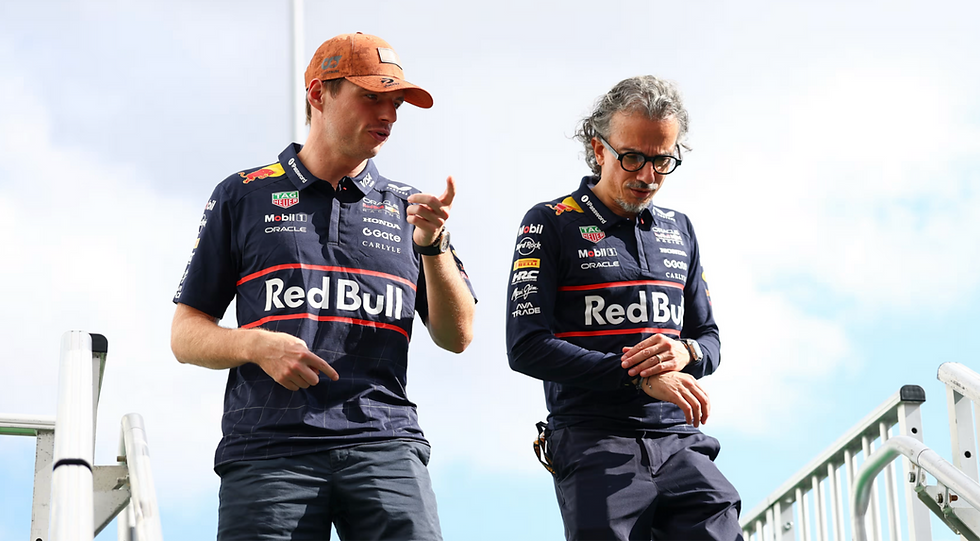
With Liambiase’s departure now on the horizon and his father, Jos Verstappen, having been vocal about the team “exploding”, the Dutchman’s loyalty to Red Bull is fraying.
Despite the chaos, Verstappen attempted to steady the ship at the 2025 Hungarian Grand Prix, saying: “Some people just like to stir the pot […] but for me, it’s always been quite clear […] I’m also staying with the team for next year.”
However, his excitement for the future is tempered by concerns over the 2026 engine and chassis regulation changes.
He has previously warned that the data for the new era “looks very bad”, suggesting he may not have the patience for a rebuilding phase.
What comes next
For Red Bull, the timing is critical. As the sport moves into a new regulatory era, they are doing so without the technical vanguard that navigated previous transitions so successfully.

While current Team Principal Lauren Mekies has attempted a resurgence, the persistent loss of senior staff suggests the bleeding has not yet stopped. While Red Bull Powertrains continues its ambitious internal engine project with Ford, the loss of people who once knew the ins and outs of the Red Bull chassis is a variable that data alone cannot replace.
If Verstappen perceives the 2026 project as a product of a diminished technical office, or if his final link to the “old guard” is severed by Lambiase’s exit, his departure before his 2028 contract expiry becomes a high probability rather than a mere paddock rumour.
In this new era of F1, Red Bull is no longer just fighting for points or championships — they are fighting to remain the team that their star driver, and the world, recognises as a serious competitor.





Comments